Eduqas · GCSE · English Language
Component 3: Spoken Language (Unweighted)
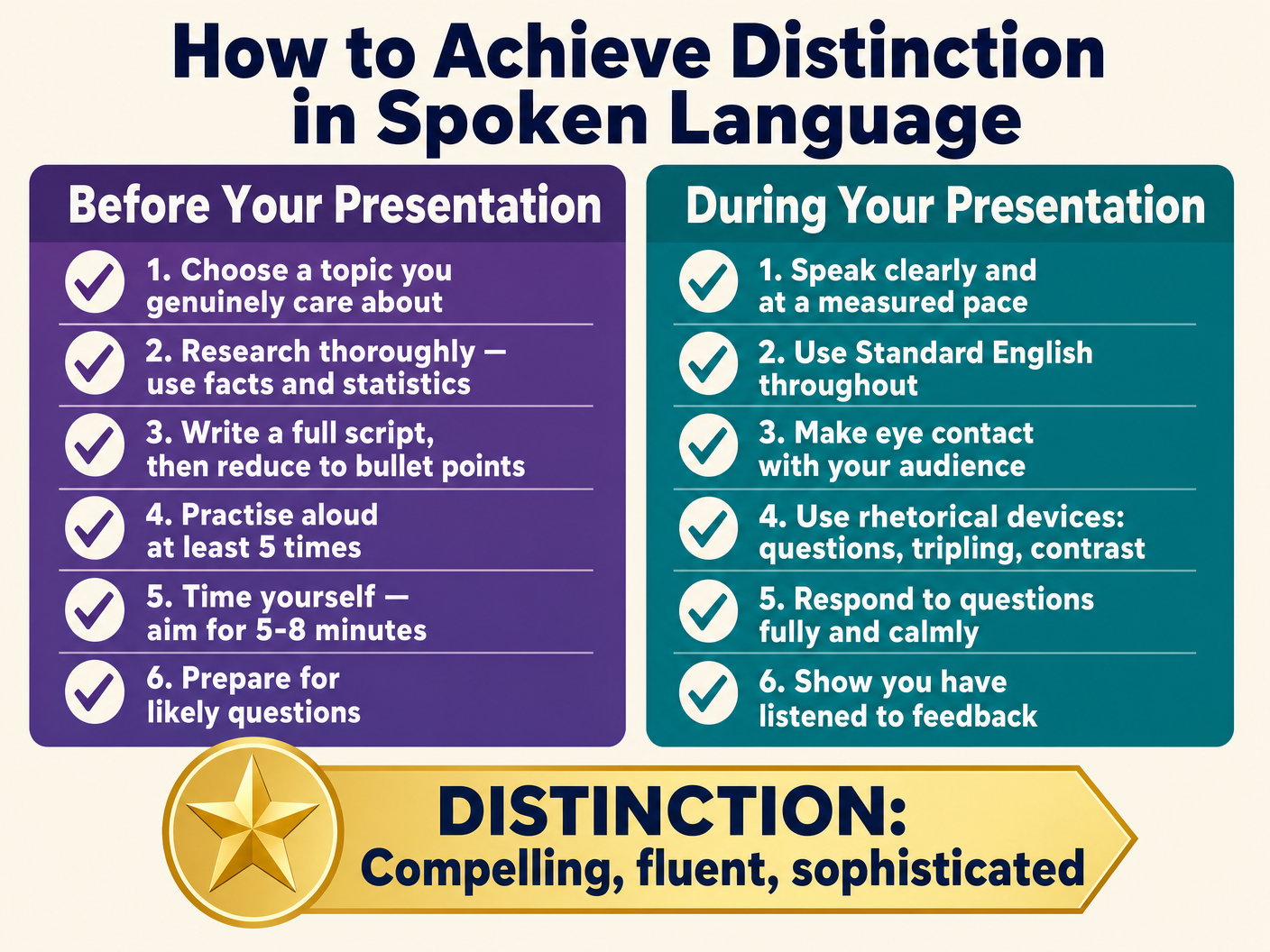
This component assesses your ability to communicate effectively in a formal spoken setting. You will be graded on presentation skills, listening and responding to feedback, and your use of Standard English to achieve a Pass, Merit, or Distinction.
- 4 min read
- 3 worked examples
- 5 practice questions
- 8 key terms
Study Notes
Overview
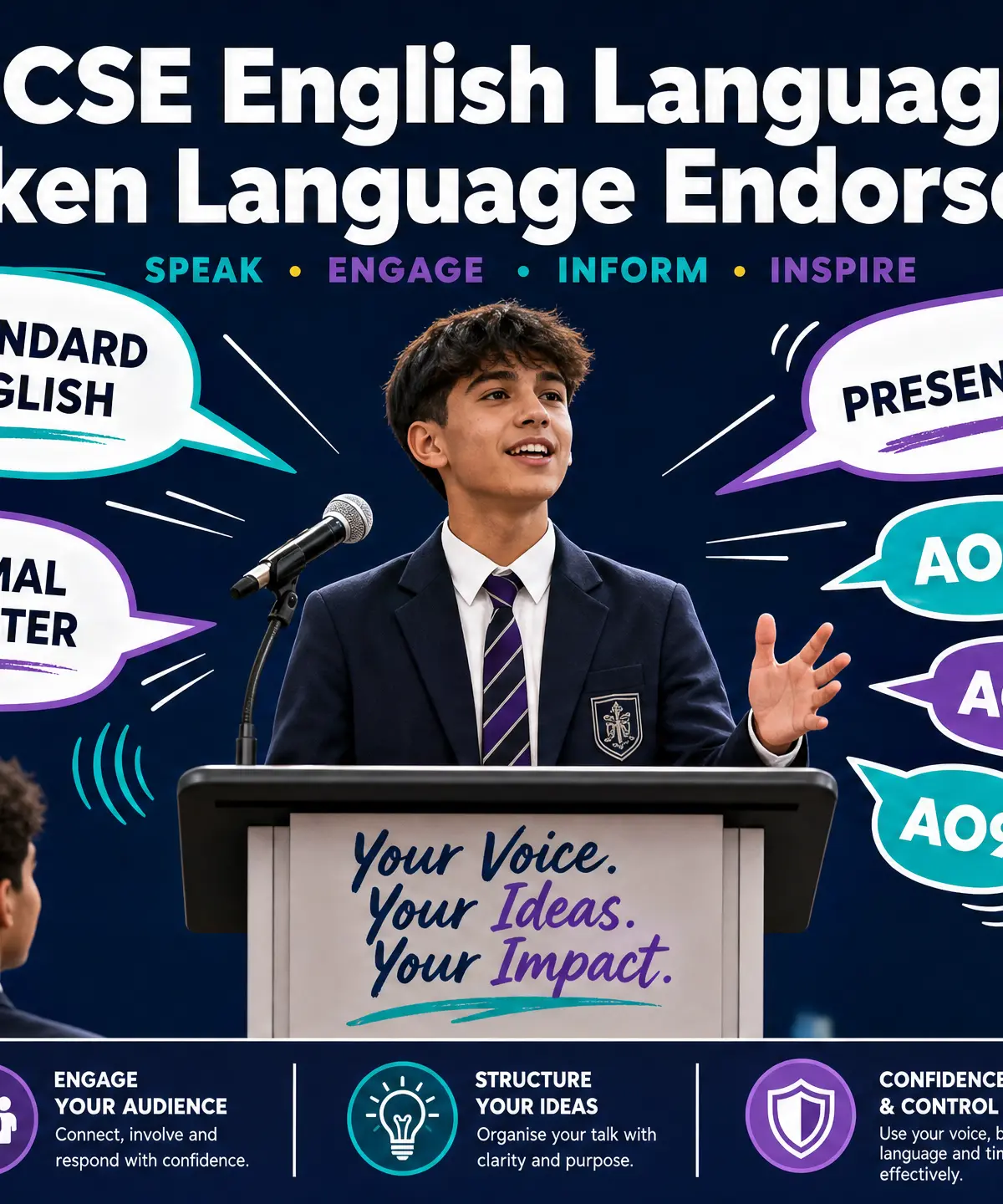
The Spoken Language Endorsement is a compulsory component of the GCSE English Language specification. While it does not contribute to your 1-9 GCSE grade, it is awarded as a separate grade (Pass, Merit, or Distinction) and appears on your final certificate. It is a fantastic opportunity to demonstrate your ability to articulate ideas, engage an audience, and think on your feet—skills highly valued by employers and universities.
The Podcast Guide
Listen to our comprehensive 10-minute audio guide covering everything you need to know to secure a Distinction:
The Assessment Objectives (AOs)
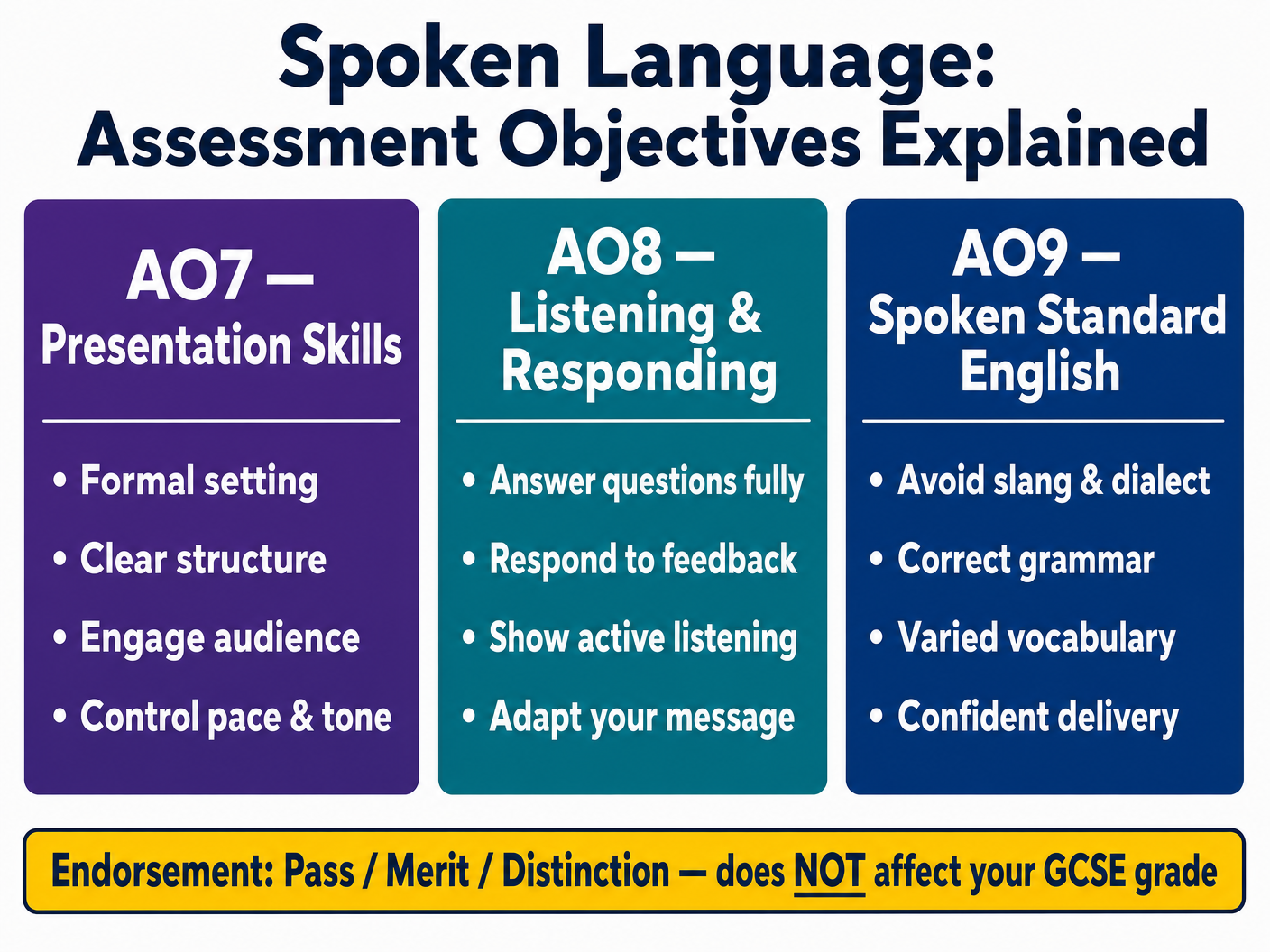
The endorsement is assessed against three specific criteria. You must meet all the criteria for a particular grade to be awarded that grade.
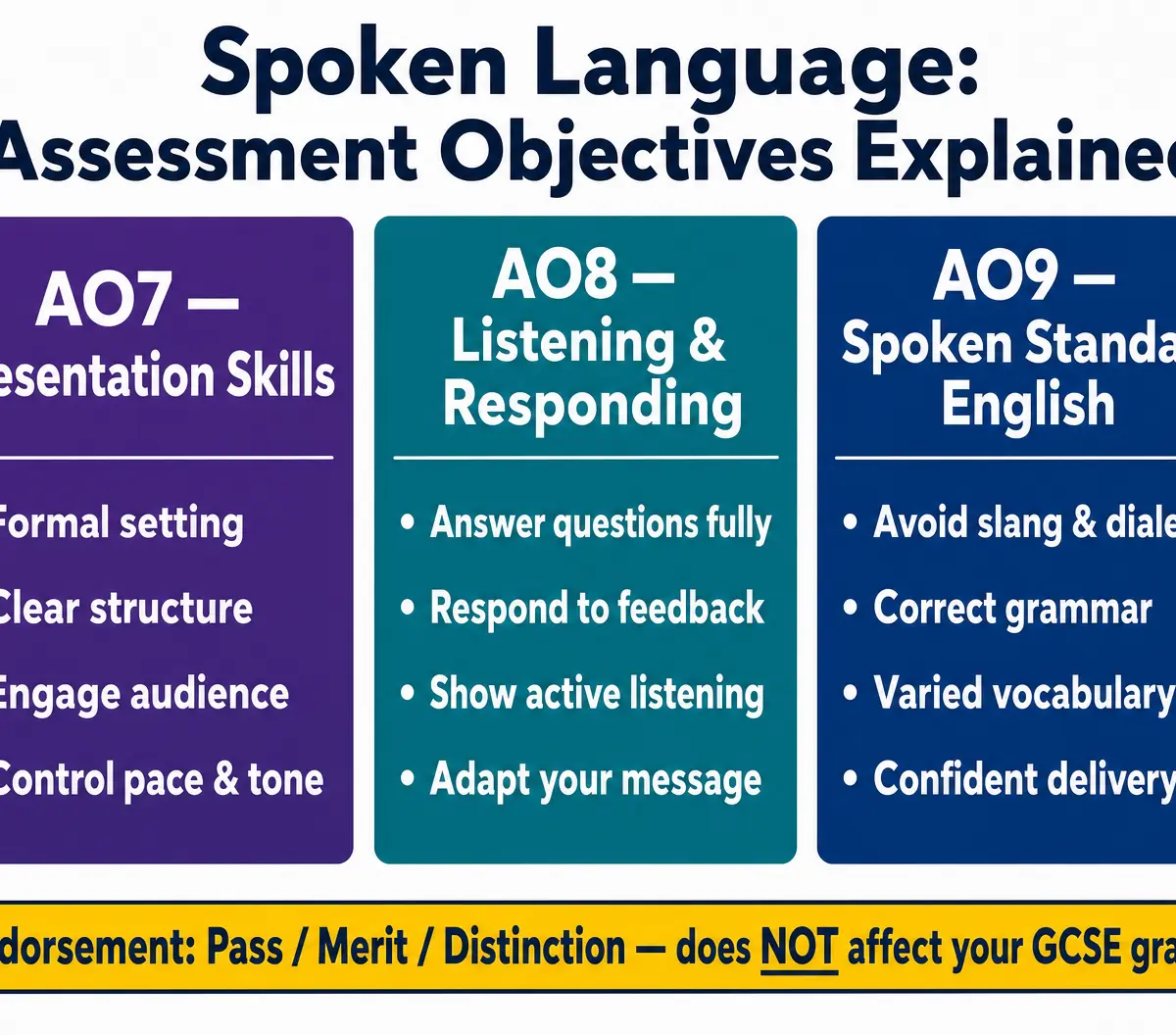
AO7: Demonstrate presentation skills in a formal setting
This objective focuses on how you deliver your talk. A formal setting means treating the presentation seriously, even if your audience is just your teacher and a few peers.
- Structure: Your presentation must have a clear beginning, middle, and end.
- Engagement: You must maintain eye contact and use body language to keep the audience interested.
- Pacing: Speak clearly, using pauses for effect rather than rushing through your notes.
AO8: Listen and respond appropriately to spoken language
This is often where candidates drop marks. After your presentation, you will be asked questions by the teacher or audience.
- Active Listening: Show you have understood the question before answering.
- Elaboration: Do not give one-word answers. Expand on your points and link them back to your main presentation.
- Handling Feedback: If someone challenges a point, respond thoughtfully rather than defensively.
AO9: Use spoken Standard English effectively
This objective is about the quality of your language.
- Grammar and Vocabulary: Avoid slang, informal fillers (like "innit" or "gonna"), and non-standard grammar (e.g., saying "we was" instead of "we were").
- Register: Maintain a formal, academic tone suitable for a presentation.
- Clarity: Use ambitious vocabulary correctly to express complex ideas.
Structuring Your Presentation
To achieve a Merit or Distinction, your presentation must be well-structured and compelling.
1. The Hook (Introduction)
Start strong. Do not begin with "Hello, today I am going to talk about..." Instead, use a rhetorical question, a shocking statistic, or a brief, powerful anecdote.
2. The Core Arguments (Main Body)
Organise your talk into 3-4 clear sections. For each section:
- Make a point.
- Provide evidence (facts, statistics, expert opinions).
- Explain the impact (why does this matter?).
3. The Call to Action (Conclusion)
Summarise your main points briefly and leave the audience with a final thought or a call to action. What do you want them to do or think about after you finish speaking?
Achieving Distinction
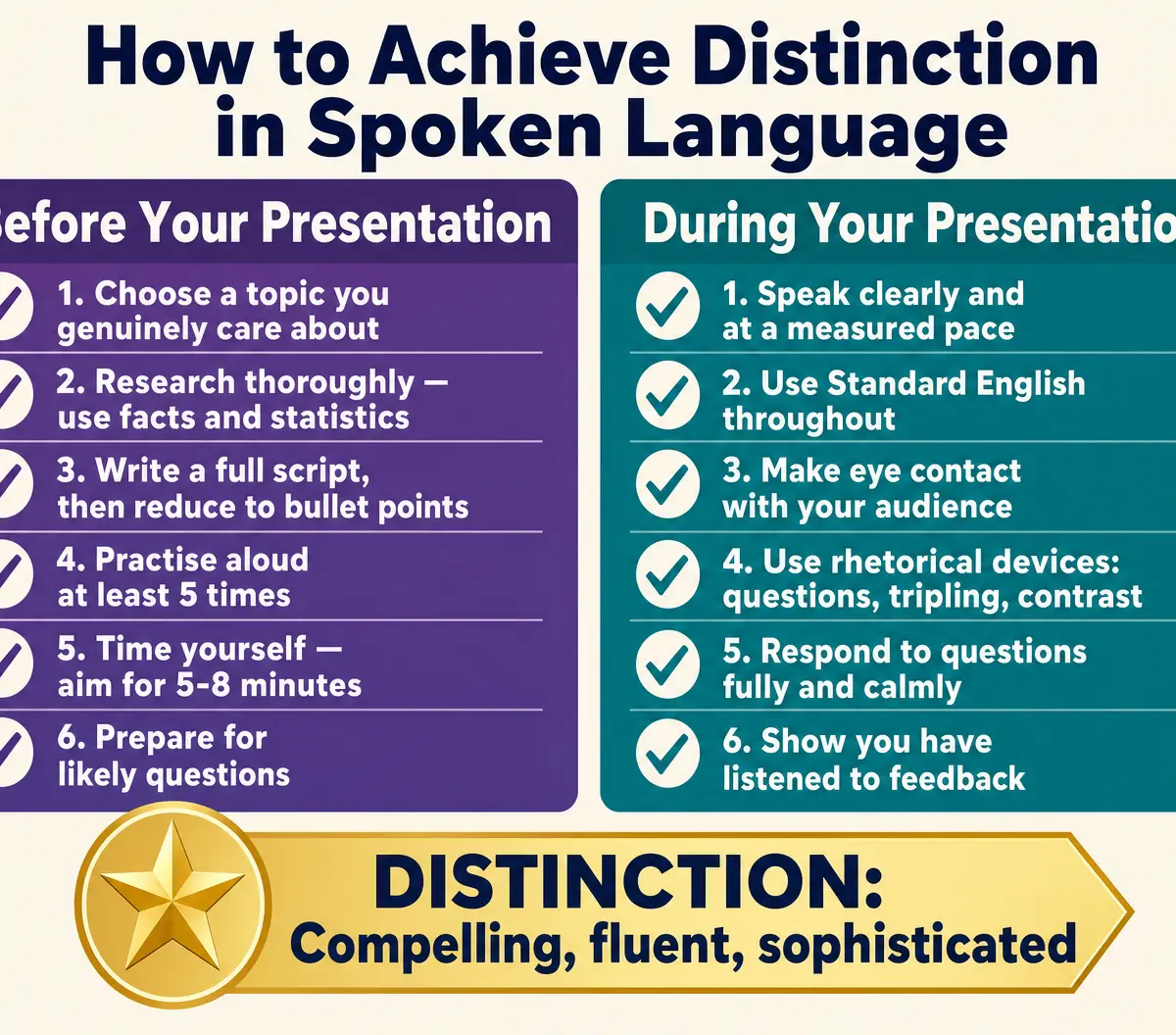
To reach Distinction level, your presentation must be sophisticated and compelling.
- Sophistication: This means exploring complex ideas, acknowledging different viewpoints, and using advanced vocabulary naturally.
- Compelling Delivery: You must speak fluently, with passion and conviction, relying on brief notes rather than reading from a script. Your responses to questions must be perceptive and detailed.
Visual Resources
2 diagrams and illustrations
Interactive Diagrams
2 interactive diagrams to visualise key concepts
Conceptual Flow Outline
The Spoken Language Preparation Workflow
Conceptual Flow Outline
How to Handle the Q&A Session Effectively
Worked Examples
3 worked examples — open one to explore the question and available guidance.
Practice Questions
Test your understanding — click to reveal model answers
Draft an engaging opening (Hook) for a presentation on the dangers of artificial intelligence.
Hint: Try using a rhetorical question or a surprising statistic rather than just introducing yourself.
A student asks you: 'But isn't it true that electric cars also damage the environment because of the lithium batteries?' Write a Merit/Distinction level response.
Hint: Use the EAR method (Empathise, Answer, Return). Acknowledge the truth in their statement before defending your point.
Rewrite the following notes into Spoken Standard English suitable for a presentation: 'Kids these days don't play outside anymore cause they're always on their phones, which is well bad for their health.'
Hint: Remove slang ('Kids', 'cause', 'well bad') and replace with formal, academic vocabulary.
Plan the structure for a 5-minute presentation on 'The importance of funding the arts in schools'. Provide the headings for your Introduction, 3 Main Points, and Conclusion.
Hint: Ensure your points build a logical argument rather than just listing random facts.
During your presentation, you completely lose your place and forget what you were going to say. How should you handle this to maintain your AO7 and AO9 marks?
Hint: Think about composure and formal language. Do not panic or swear.